
Your goals shouldn't fade after two weeks.
pegore gives your objectives a structure that sticks — measurable key results, quarterly framing, and zero daily reminders telling you you're behind.
New to OKRs? Learn the basics in 4 free lessons
A tool that gets out of your way
Every screen shows exactly where you stand. Nothing more, nothing less.
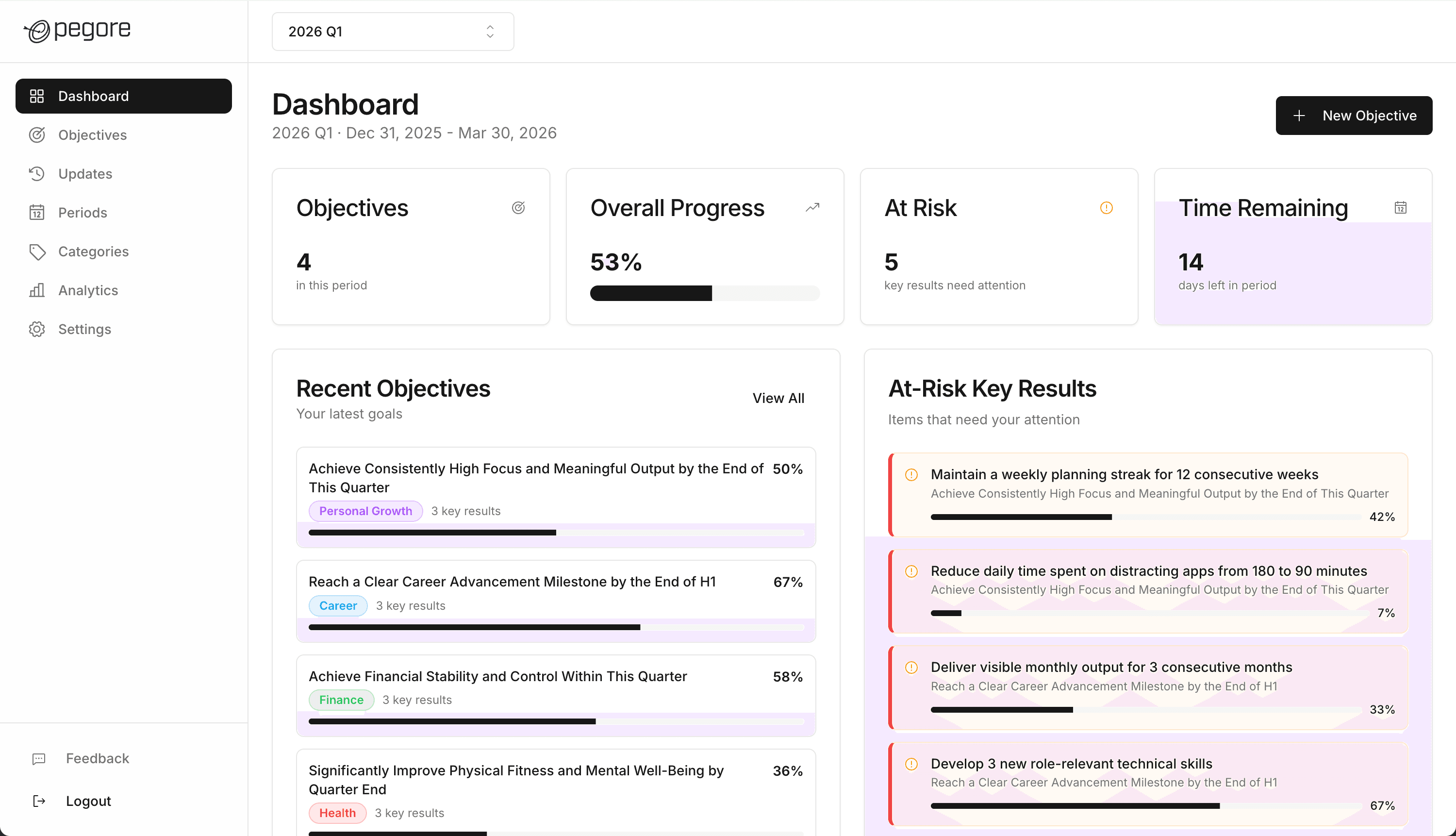
Built around how personal goals actually work
Not a watered-down team tool. Not a daily habit tracker. Something built from the ground up for individual outcomes.
Goals that stay in focus
Write 2–5 objectives per quarter in plain language. Pick a priority. Done — no frameworks to learn, no formats to memorize.
See exactly where you stand
Visual progress across every goal at a glance. Know in a second whether you're on track — or need to push.
Think in quarters, not just today
Organize goals by quarter, month, or any custom window. Switch periods without losing history.
Log progress in under 10 seconds
Tap a key result, enter a number, done. No forms, no status updates — just a number and an optional note.
The right measure for every goal
Saving money? Track currency. Running 3×/week? Track streaks. Finishing chapters? Track milestones. Not every goal is a percentage.
Your goals are yours alone
Everything you track stays private. No team views, no manager dashboards, no data shared with anyone.
- 60–70%
- success rate for ambitious OKRs
- 10
- metric types built in
- < 5 min
- to your first OKR
- 90 days
- the OKR quarter
OKRs were developed at Intel by Andy Grove and popularized at Google by John Doerr. The 60–70% target rate for stretch goals is documented in Measure What Matters (Doerr, 2018).
Up and running in minutes
No onboarding call. No template setup. No tutorial to sit through.
Set Objectives
Write 2–5 goals for the quarter. Name them clearly. Set a priority — Critical, High, or Nice to have.
Add Key Results
Choose how to measure each goal. Books read? Money saved? Workouts logged? Pick the metric that fits.
Check In
Update when it happens — weekly, biweekly, whenever. Log a number, add a note, move on. No streaks, no guilt.
Frequently Asked Questions
Common questions about OKRs and pegore
What is OKR?
OKR stands for Objectives and Key Results. It is a goal-setting framework that defines what you want to achieve (Objectives) and how you measure success (Key Results). OKRs are typically set quarterly and help individuals and teams focus on measurable outcomes.
How do personal OKRs work?
Personal OKRs work by setting 2-5 qualitative objectives per quarter, each with 2-5 measurable key results. You track progress through regular check-ins (weekly or biweekly), update your metrics, and review results at the end of the cycle. Achieving 60-70% of ambitious targets is considered successful.
What is the difference between OKRs and KPIs?
KPIs (Key Performance Indicators) are ongoing health metrics you monitor continuously, like revenue or customer satisfaction. OKRs are time-bound targets for specific improvements. KPIs answer “How is this area performing?” while OKRs answer “What specific change do I want to achieve by when?” They complement each other well.
Can I use OKRs for personal goals?
Yes. OKRs work well for personal goals — health, finance, learning, relationships, and side projects. The framework was popularized by Google and Intel for teams, but the same structure (a qualitative objective with measurable key results, reviewed quarterly) applies directly to individual goal-setting. pegore is built specifically for this use case.
How is pegore different from team OKR tools like Lattice or 15Five?
Team OKR tools are built for managers and HR teams — org charts, review cycles, and reporting for dozens of people. pegore strips all of that away. No team features, no shared access, no overhead. Just set goals, track progress, review each quarter.
How many OKRs should I set per quarter?
Most practitioners recommend 2–5 objectives per quarter, each with 2–5 key results. Google and other early OKR adopters consistently found that 3–4 objectives per cycle produces the best outcomes. More than 5 objectives spreads effort too thin.
Is pegore free?
Yes. pegore is free during public beta. No credit card required. Sign up and create your first OKR in under 5 minutes.
What is pegore?
pegore is a personal goal tracker built for individuals who want to apply the OKR framework to their personal lives — not their work teams. It supports 10 metric types (percentages, numbers, currency, milestones, streaks, and more), flexible period management (quarterly, monthly, custom), and visual progress tracking. Free during public beta.
Tried Notion? Habitica? A spreadsheet?
Here's why they didn't stick — and what pegore does differently.
pegore vs Notion
Notion can do anything — which means you spend more time setting it up than tracking goals. pegore is the system, ready on day one.
pegore vs Habitica
Habitica rewards you for showing up daily. pegore tracks whether your big goal is actually moving. Different problem, different tool.
pegore vs Spreadsheets
Spreadsheets track numbers but not momentum. pegore gives you structure, visual progress, and one clear question: are you on track?
The occasional update from pegore
New features, goal-setting tips, and OKR insights. One email at a time — no noise.